
The certainty of decay
Tendo como inspiração a natureza-morta de Pieter Claesz, de 1645, desafiei-me na criação de uma interpretação contemporânea de elementos que representam este género artístico, que se imprimiu em diversas correntes artísticas ao longo dos séculos e que tem permitido a exploração e comunicação de reflexões profundas sobre temas intemporais como vida, a morte, a ostentação e a decadência.
O grés cerâmico, como veículo da minha expressão, permitiu-me explorar alguns elementos imortalizados na obra de Pieter Claesz, numa conversa entre texturas, formas imperfeitas e cores vibrantes e que intencionalmente se apresenta de forma diametral ao hiper-realismo da obra de Claesz.
A natureza morta holandesa do século XVII remete-nos para a dualidade fascinante entre a profusão de beleza e exuberância do detalhe e a decadência dos organismos vivos e transitoriedade da vida e dos bens terrestres.
É neste plano do efêmero e da deterioração que o elemento central da minha peça entra: o bolor. Ainda que surja discretamente ou metaforicamente na natureza-morta, este fungo, símbolo de decomposição, é um lembrete visual da impermanência da vida. A placa de Petri, inventada no século XIX, permite visualizar o processo de degradação e proliferação de organismos como o bolor.
Assim, o que vemos na placa de Petri pode ser visto como uma extensão moderna da natureza morta – um novo tipo de composição visual onde a matéria orgânica ainda fala da passagem do tempo. Duas abordagens, com séculos de distância, a mesma verdade: tudo está em constante transformação, e nada escapa à decadência.
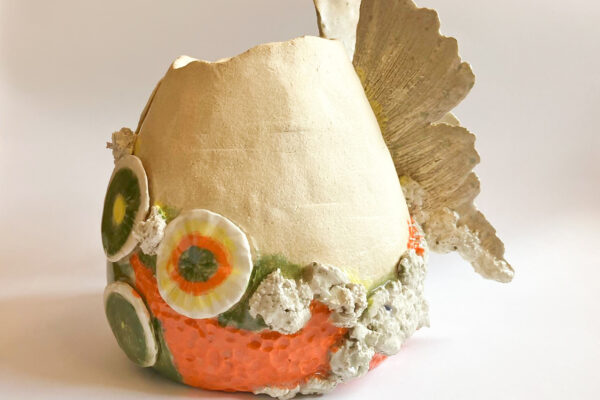
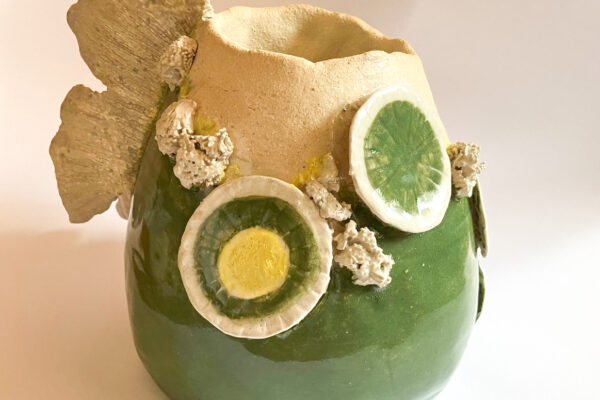
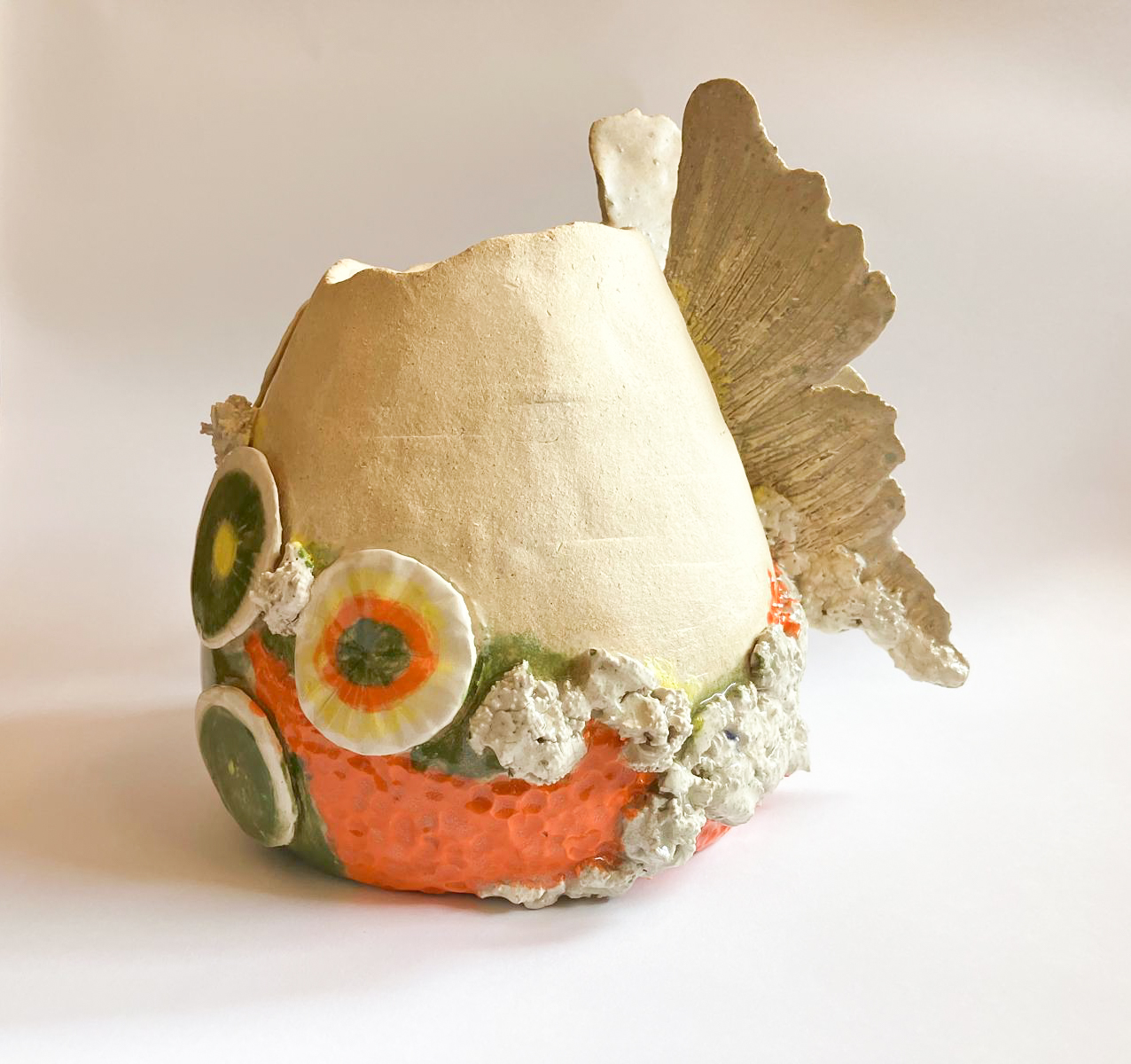
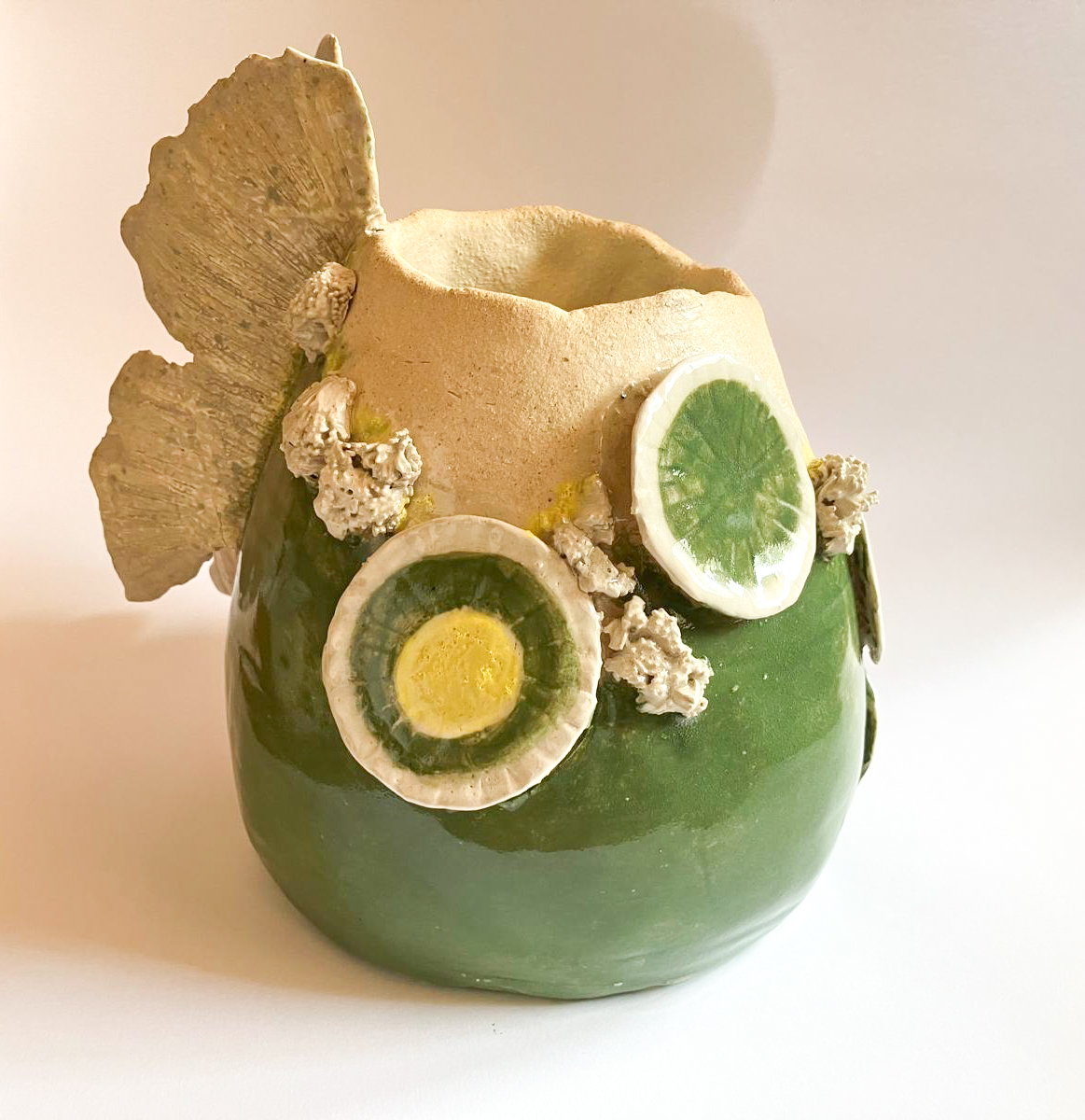
Através de uma abordagem exploratória, tentei representar na minha peça, a proliferação do fungo, a sua aparente aleatoriedade, numa estrutura de forma ovalada, quiçá um limão descascado, símbolo multifacetado da futilidade dos prazeres mundanos, passageiros e sujeitos à decomposição.
O outro elemento que compõe a peça surge alado e frágil. Uma borboleta talvez, com a sua curta e delicada vida, enfatiza a transitoriedade da vida.
grés, queimada a 1200º, engobes e vidrado
altura: 20cm; diâmetro inferior: 16 cm; diâmetro superior: 10 cm.
English
The certainty of decay
Taking inspiration from Pieter Claesz’s 1645 still life, I challenged myself to create a contemporary interpretation of elements that represent this artistic genre—one that has appeared in various art movements over the centuries and has allowed for deep reflection and communication on timeless themes such as life, death, opulence, and decay.
Stoneware, as the medium for my expression, allowed me to explore some of the elements immortalized in Claesz’s work through a dialogue between textures, imperfect forms, and vibrant colors—intentionally presented in stark contrast to the hyperrealism of Claesz’s painting.
17th-century Dutch still life evokes the fascinating duality between the abundance of beauty and detailed exuberance, and the decay of living organisms and the transience of life and earthly possessions.
It’s in this realm of the ephemeral and deteriorating that the central element of my piece appears: mold. Although it appears discreetly or metaphorically in traditional still life, this fungus—a symbol of decomposition—is a visual reminder of life’s impermanence. The Petri dish, invented in the 19th century, enables us to see the process of degradation and the proliferation of organisms like mold.
Thus, what we see in the Petri dish can be understood as a modern extension of still life—a new kind of visual composition where organic matter still speaks of the passage of time. Two approaches, centuries apart, the same truth: everything is in constant transformation, and nothing escapes decay.
Through an exploratory approach, I attempted to represent in my piece the proliferation of the fungus—its apparent randomness—in an oval-shaped structure, perhaps a peeled lemon, a multifaceted symbol of the futility of worldly pleasures: fleeting and subject to decomposition.
The other element in the piece appears winged and fragile. A butterfly, perhaps, with its short and delicate life, emphasizes the transience of existence.
stoneware, fired at 1200º, slips and glaze
altura: 20cm; diâmetro inferior: 16 cm; diâmetro superior: 10 cm.
Susana Silva
Nasci e cresci no Porto. Licenciei-me em Psicologia e mais tarde estudei Ilustração e produção Gráfica.
Em 2014 mudei-me para a Irlanda do Norte, local onde me reconectei com duas paixões antigas, a ilustração e a flora.
Os meus projetos pautam-se pela síntese das formas e por paletas de cores reduzidas e vibrantes, explorando a tensão harmoniosa entre o minimalismo e a intensidade. Inspiro-me no feminino e na natureza. Dedico-me à ilustração, projetos gráficos e mais recentemente a aprender cerâmica.
https://www.behance.net/sigsillustration
English
I was born and raised in Porto. I graduated in Psychology and later studied Illustration and Graphic Production.
In 2014 I moved to Northern Ireland, where I reconnected with two old passions: illustration and flora.
My projects are guided by the synthesis of shapes and reduced vibrant color palettes, exploring the harmonious tension between minimalism and intensity. I am inspired by the feminine and nature. I dedicate myself to illustration, graphic projects and, more recently, learning ceramics.
https://www.behance.net/sigsillustration
Cor Própria
Rua do Rosário, 129